
The Public Domain Review
About The Public Domain Review
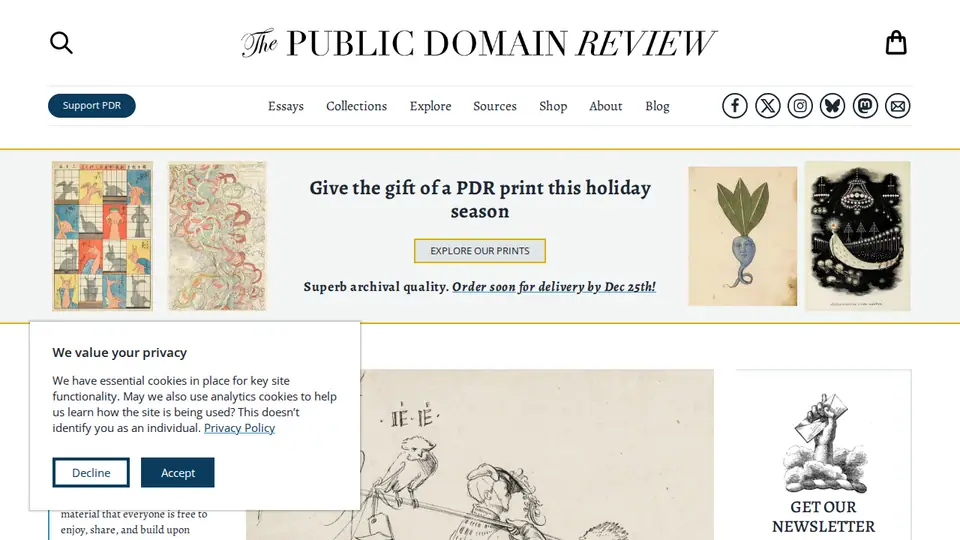
The Public Domain Review is an online journal about works from the history of art, literature and ideas that are now out of copyright. It publishes a fortnightly series of essays by scholars, authors and archivists, and curated collections of images, books, audio and film found in online archives, each with commentary and links to the source. New pieces are added every week, and the archive holds more than 1,200 articles.
It is for curious readers, artists, designers and researchers looking for unusual and beautiful historical material, much of which can be reused freely.
Reading is free and needs no account. The project is a not-for-profit funded by donors, known as Friends, and by a shop selling prints and books. A newsletter goes out every fortnight. Founded in 2011, it has been praised by The Guardian and The New York Times. The site is in English.
Malware and phishing scan
No threats found by Google Safe Browsing on 20 Nov 2026.Google Safe Browsing is the list of dangerous websites that Chrome, Safari and Firefox use to warn people before a page opens. Once a week we look up this site's address in it for malware, phishing, unwanted software and harmful downloads.Check publicdomainreview.org yourself on Google's site. Advisory provided by Google. No scan can guarantee that a site is safe.Updates from readers
Changed address, new pricing, broken link? Tell us. 1 entry so far.
Reviews
No reviews yet. Be the first to write one.
The Public Domain Review: common questions
What is The Public Domain Review?
Online journal of essays and curated collections exploring public-domain art, books, film and audio. The Public Domain Review (publicdomainreview.org) is listed under General on PirateVault. It is tagged art history, curiosities, essays, old books, public domain and vintage images.
Is The Public Domain Review safe?
Google Safe Browsing reported no malware, phishing, unwanted software or harmful downloads for publicdomainreview.org when we last looked it up on 20 November 2026. The site uses a secure (HTTPS) connection, checked on 20 November 2026. The scan is repeated every week and the result is shown on this page. No scan can guarantee that a website is safe.
Is The Public Domain Review legit?
An editor of PirateVault reviewed The Public Domain Review before it was listed. It passes all 4 required verification checks and carries the Verified badge. Members rate it 3.5 out of 5 from 38 counted voters. Each check and its date is public on this page. PirateVault checks that a site works and is free of known threats; whether using it is lawful where you live is for you to judge.
Is The Public Domain Review down or working right now?
The Public Domain Review was online and answering when we last checked publicdomainreview.org on 22 November 2026. Over the last 30 days it answered 100.0% of our checks. The link is tested automatically and the latest result is always shown here.
What is the official The Public Domain Review website address?
The address we link to is https://publicdomainreview.org. Readers and editors report address changes on this page, so the link is kept current; be careful with look-alike sites that use a similar name.
Is The Public Domain Review free?
Yes. The Public Domain Review is free to use.
Do you need an account to use The Public Domain Review?
No. The Public Domain Review can be used without creating an account.
How good is The Public Domain Review? Ratings and reviews
The Public Domain Review has an overall score of 3.5 out of 5 and is ranked #39 in General, from the votes of 38 members. Anyone signed in can rate it, one vote per person.
What are the best alternatives to The Public Domain Review?
Sites like The Public Domain Review in General include MIT OpenCourseWare, Khan Academy, Repair Wiki, World History Encyclopedia and WikiArt. The General list ranks all of them by member votes.
These answers are written from this listing's live data (the checks and their dates, the ratings, the facts recorded by editors) and change when the data does. How rankings work